
Episode notes
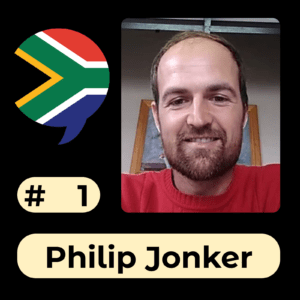
This episode’s guest is someone I met back in 2018 when I first started learning isiXhosa in earnest. Philip was my house-mate in a rural Eastern Cape village for a brief 3 month period, and graciously gifted me with an isiXhosa dictionary.
Summary
In this episode, we hear how Philip, an Afrikaans speaker from a farming community in the Western Cape, learnt (and continues to learn) isiXhosa. Though Philip’s parents wanted him and his siblings to learn the language as a child – through a nanny – this early attempt failed.
His interest began during his second year at university when he discovered a self-learning isiXhosa book at home. Motivated by a desire to bridge racial and cultural boundaries, he started learning isiXhosa with a friend using a self-instruction manual, engaging in language basics with isiXhosa-speaking friends, and by listening to the South African artist Zahara.
By the end of university, his isiXhosa proficiency was very basic, but his determination led him to work at a rural NGO in Zithulele (in the Mqanduli district, near Coffee Bay), where he began immersing himself in the language.
Philip’s learning process in Zithulele involved informal methods such as creating small vocabulary lists that lived in his pocket, reading children’s books, and practising with the local amaXhosa people. His grammar studies were a mix of intuition and his trusty Lumko self-instruction manual.
After several years, and after transitioning his work to the local building industry, Philip has become more comfortable with more complex aspects of the isiXhosa language, e.g. reasoning and negotiation, especially in conversations that involve social etiquette, teamwork, and managing requests. These interactions have improved his language proficiency, which he estimates to be around 6 or 7 out of a possible 10. Though he still struggles with idiomatic expressions, he feels confident in day-to-day communication.
His ability to speak isiXhosa has deepened his relationships in the community and allowed him to integrate more fully, breaking down barriers and building trust. While no longer actively studying the language, Philip continues to learn through conversations and has started dabbling in Sesotho.
Mentioned in this episode:
- Lumko isiXhosa Self-instruction Manual (LLSA | AbeBooks)
- Find out more about Zithulele
This podcast is a project of Language Learning SA
Language Learning SA home page | Monthly Newsletter | Youtube | Spotify | WhatsApp Channel | Facebook | LinkedIn | X
I hope you enjoy this conversation, please give feedback in the comments section and share it with anyone who you think might want to hear Philip’s story.
Feel free to buy me a coffee if you’d like to support this podcast!