
Episode notes
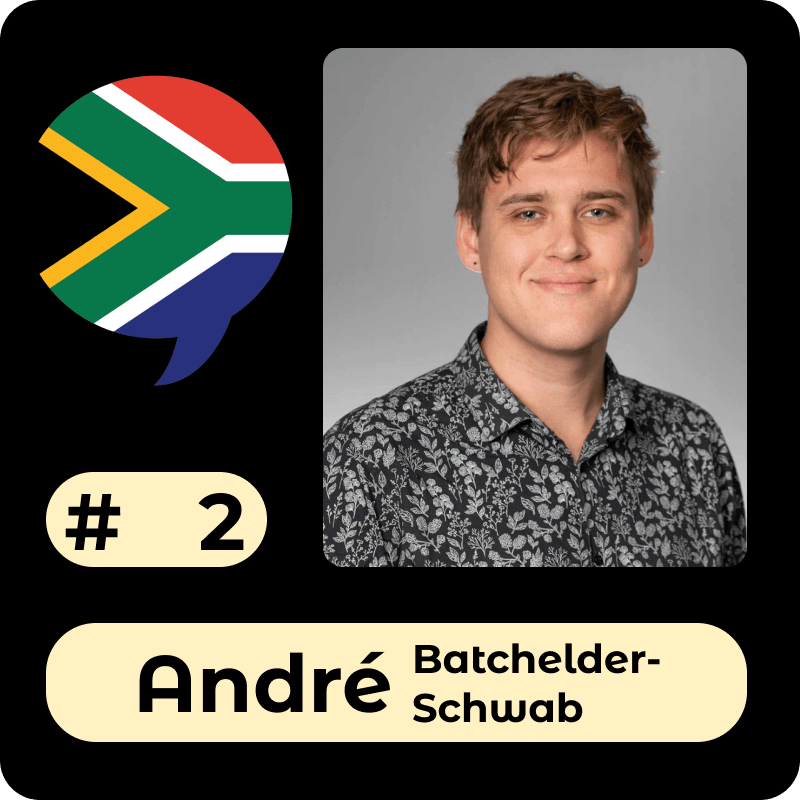
In this episode, I interview André Batchelder-Schwab, a PhD student at Boston University with extensive experience in language learning, including Arabic. With a strong background in linguistics driving his passion for languages, Andre has taken on the challenge of learning isiXhosa, a journey made even more unique by the fact that most of his learning has occurred outside of South Africa, with only a brief visit to the country. We’ll explore how his linguistic expertise has shaped his approach to learning isiXhosa and his experience of learning and reception by isiXhosa speakers.
Summary
Andre’s journey in learning isiXhosa reflects a diverse linguistic background and a deepening passion for languages. Originally from a French-speaking environment, he also learned German, Latin, and English, the latter becoming dominant after moving to the U.S. 15 years ago.
Initially aiming for international relations (with an undergrad studying Arabic), Andre shifted to linguistics after helping a roommate with phonology. He had previously spent some time getting to know Khoikhoi (and was thus familiar with clicks) – and decided to choose isiXhosa during his PhD to deepen his understanding of languages from the Bantu group.
Starting isiXhosa with no prior knowledge (other than familiarity with even more complex click sounds), he found its structure easier compared to Arabic, especially due to vocabulary cognates with English and Afrikaans. However, he faced challenges with tone, which he found easier after understanding whistled versions of languages like Tshivenda and isiXhosa.
Listening comprehension was also a challenge, particularly transitioning from written to spoken language. Andre credited his lecturer with significantly aiding his progress, emphasizing the benefit of his small class size and personalized attention. He engaged in extensive reading, listening/transcription in preparation for class and conversation during class, dedicating about ten hours a week to learning isiXhosa, for 30 weeks a year, for around 4-5 years.
Despite only being in isiXhosa dominant areas of South Africa for a total of 2 weeks (in [the US] summer of ’24), his learning abroad enabled him to feel comfortably fluent when speaking with Xhosa people. He described giving a “presentation at the University of Fort Hare, where I basically gave this full talk in isiXhosa to an isiXhosa audience … I have no issue talking to anyone.” Andre recounts largely positive interactions with Xhosa speakers, including a memorable experience at a restaurant where staff rewarded his use of isiXhosa with free drinks.
Mentioned in this episode:
Read more about André and his research here:
This podcast is a project of Language Learning SA
Language Learning SA home page | Monthly Newsletter | Youtube | Spotify | WhatsApp Channel | Facebook | LinkedIn | X
I hope you enjoy this conversation, please give feedback in the comments section and share it with anyone who you think might want to hear Andre’s story.
Feel free to buy me a coffee if you’d like to support this podcast!